



Traditional CRM vs. AI-Powered CRM
For twenty years, a CRM has been a system of record: a place to store contacts, log activities, track deals through pipeline stages, and report on what happened. The person using it does the thinking — they decide who to call, what to say, and when to move a deal forward. The CRM just remembers.
An AI-powered CRM changes that division of labor. The same contacts, companies, deals and activity history are still there, but a layer of AI sits on top of them, reads them, and can act on them. It can summarize a messy email thread before a call, flag which deals are stalling, draft a follow-up, or research a prospect before anyone on the team opens the record. The data doesn't just get stored anymore — it gets used.
HubSpot has spent the last two years building exactly that layer, under the name Breeze. The question worth asking isn't whether HubSpot has "AI features" — most CRMs do by now. It's whether that AI is deeply wired into the CRM's own data, or bolted on as a chat window that happens to sit next to it. That distinction is what actually separates a traditional CRM from an AI-powered one.
What Makes HubSpot an AI-Powered CRM?
Five things, in particular, separate Breeze from a chatbot glued onto a CRM.
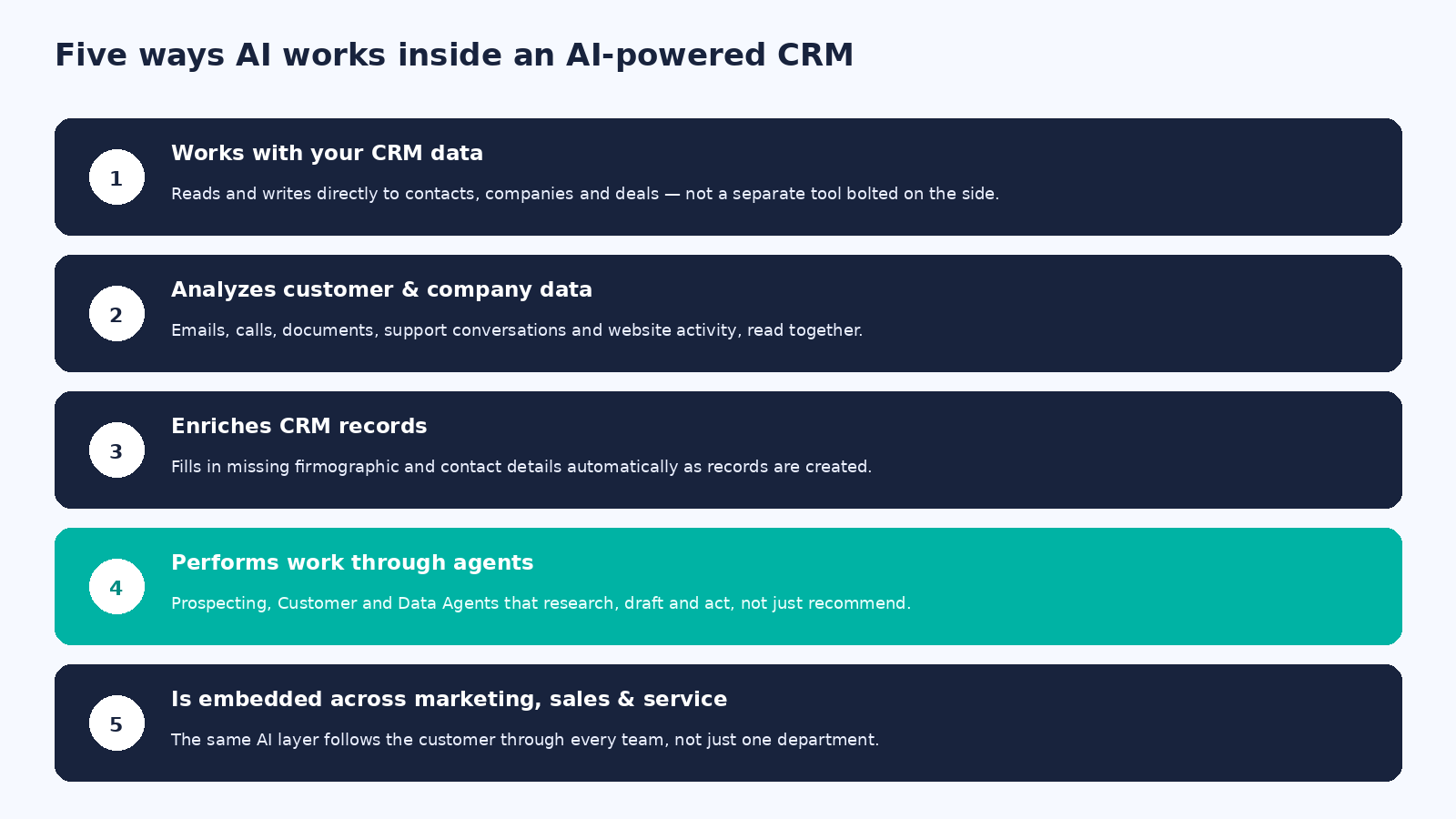
1. AI works with your CRM data
HubSpot's Breeze AI reads and writes directly against contacts, companies, deals and tickets. It isn't a separate assistant answering from general knowledge — every summary, suggestion or draft it produces is grounded in the actual records sitting in the CRM.
2. AI can analyze customer and company data
Breeze can look across everything the CRM already holds on a person or a company, not just one field at a time:
- Contacts
- Companies
- Deals
- Emails
- Calls
- Customer interactions
- Documents
- Support conversations
- Website information
That combination is what lets the Breeze Assistant answer a question like "what's the state of this account" with a synthesized answer pulled from all of it, instead of a rep scrolling through six tabs.
3. AI can enrich CRM records
Incomplete records are one of the oldest problems in CRM. Breeze's data enrichment fills in missing firmographic and contact details automatically as records are created or updated, instead of leaving a form half-filled and hoping someone fixes it later.
4. AI can actually perform work
This is the biggest shift. Breeze doesn't stop at analysis — it can act, through a set of AI agents built for specific jobs:
- Prospecting Agent — researches accounts and drafts personalized outreach.
- Customer Agent — handles support questions using the knowledge already in the CRM and knowledge base.
- Data Agent — finds and fixes gaps or inconsistencies in CRM data.
- Agent Builder — lets a business assemble a custom agent for a workflow HubSpot doesn't ship out of the box.
The CRM is moving from a system that records work to a system that can participate in doing the work.
5. AI is embedded into marketing, sales and service
None of this lives in a separate "AI" tab. The same AI layer follows the customer across HubSpot's Marketing, Sales and Service Hubs, so a lead worked on by marketing carries the same context into a sales conversation and, later, a support ticket.
From CRM Automation to AI Agents
Workflow automation and AI agents can look similar from a distance — both do things without a human clicking every step. The difference is in the loop each one runs.
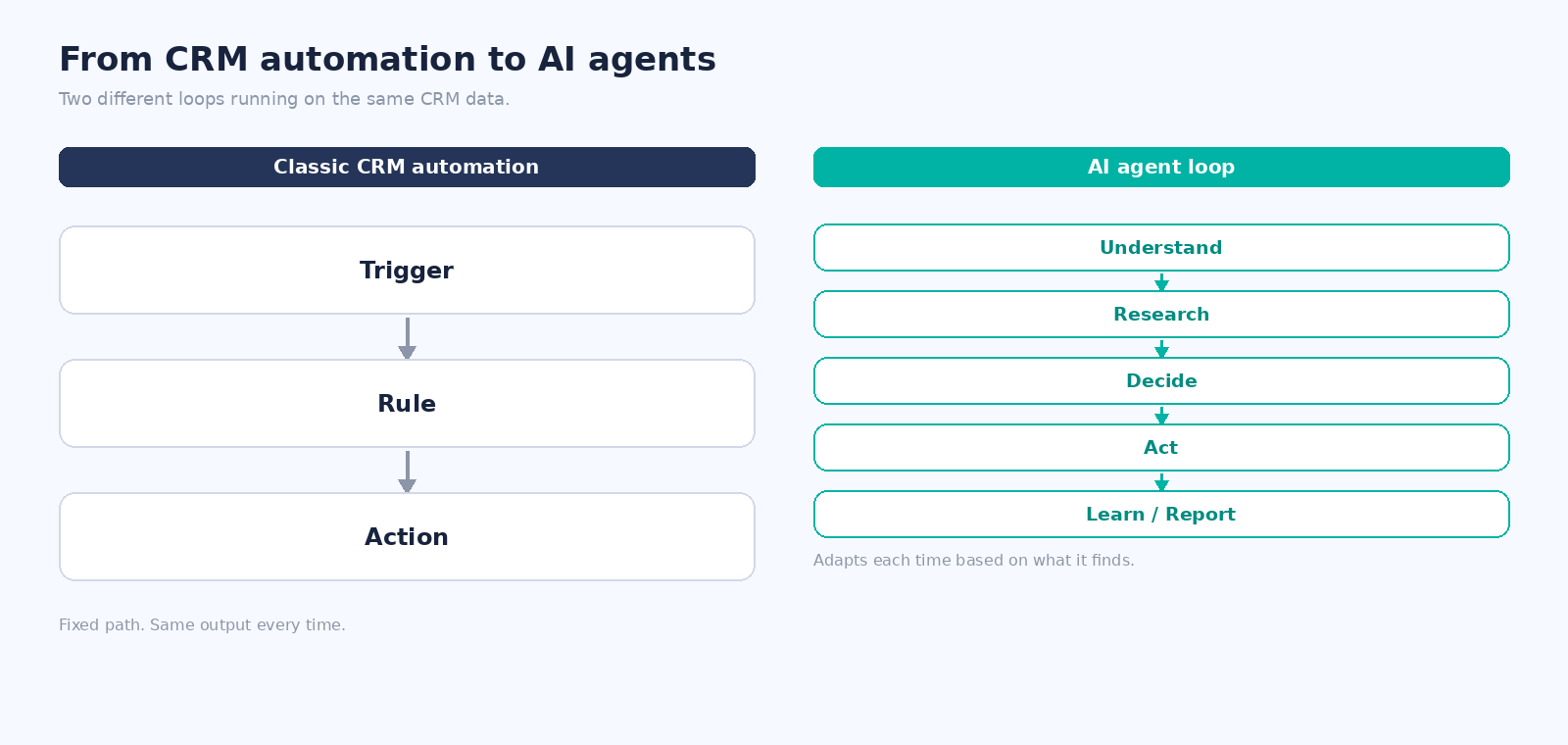
Classic CRM automation runs Trigger → Rule → Action. A deal moves to a stage, a rule fires, a task gets created. It's fast and predictable, but it can only do what it was explicitly told to do, and it does the same thing every time no matter what's actually going on in the record.
An AI agent runs a longer loop: Understand → Research → Decide → Act → Learn / Report. Take a stalled deal as an example. A workflow rule can only notice the deal hasn't moved and notify the owner. A Breeze agent can read the deal's email thread, understand why it stalled, check whether the contact opened the last proposal, decide whether a follow-up or an internal escalation makes more sense, draft that follow-up, and report back on what it found — adapting each time based on what's actually in the record, not a fixed script.
Is HubSpot Really an AI-Powered CRM?
Yes — with a caveat. HubSpot's AI is genuinely wired into the CRM's core objects, not stapled on as a separate product. It works with the same:
- Business data
- Customer context
- Workflows
- Automation
- Business rules
- CRM records
- Actions
that the rest of the platform already runs on. The caveat: how much of that potential a business actually gets depends on how well the CRM itself is set up. AI reading messy, duplicate, or badly structured data will produce messy, duplicate, or badly structured output. The AI is only as good as the CRM underneath it.
What Does This Mean for Businesses?
The practical effect is a shift in where people spend their time, not the disappearance of the role itself.
Humans should focus on: relationships, negotiations, strategy, complex decisions, and closing important deals.
AI can increasingly handle: research, data enrichment, lead qualification, follow-ups, summaries, customer questions, CRM updates, and repetitive workflows.
That's not a small list. Most of what fills a rep's or a support agent's day — the research before a call, the recap after it, the CRM update that never quite happens — is exactly the work AI agents are built to absorb, which leaves more of the day for the parts of the job that actually need a person.
HubSpot vs. Traditional CRM at a Glance
| Area | Traditional CRM | AI-Powered CRM (HubSpot Breeze) |
|---|---|---|
| Role of the CRM | System of record | System of record and action |
| Who does the analysis | The person using it | AI, grounded in CRM data |
| Data entry | Manual, often incomplete | Enriched automatically |
| Follow-ups & research | Done by hand, if there's time | Drafted or handled by an agent |
| Automation style | Fixed rules: Trigger → Action | Adaptive: Understand → Decide → Act |
| Coverage across teams | Siloed by hub or tool | Shared context across marketing, sales, service |
| Where humans spend time | Data entry and routine follow-up | Relationships, strategy, closing deals |
The Future of CRM
The question a CRM is built to answer has quietly changed. It used to be: "Where is my customer information?" Then automation made it: "What should I do next?" Now, with AI agents wired into the data itself, the question becomes: "Can you do it for me?"
That's the direction HubSpot is building toward with Breeze — and it's the direction the whole CRM category is heading, whichever platform a business runs on.
Thinking About an AI-Powered CRM?
Choosing the right CRM is only the beginning. The real value comes from designing the right data structure, workflows, automation and AI agents around your business.
GoBizIT helps businesses design and implement AI-powered CRM and automation solutions. Book a free consultation and learn how AI can transform your business.